


Natural-Edge Bowls – Working with Tension, Shape and Character
A blog about natural-edge bowls? Why? Well, simply because they are incredible fun to make, because I sometimes see absolutely stunning bowls go by — but also terribly ugly ones! And because there are always practical tips to share…
Turning a natural-edge bowl from a solid piece of wood with the bark still on is simply great fun. When a sharp gouge glides smoothly through fresh wood, even the grumpiest woodturner instantly becomes cheerful again… And when you sell or give one away, there’s guaranteed to be a heartfelt “ooooh” or “aaaah.”
You work with wood that is still alive — with tension, moisture, bark, wild shapes and unpredictable structures. That is exactly what makes these bowls so special. No two pieces are ever the same. But working with living wood also means challenges: cracking, splitting and warping are always lurking. While turning, I try to follow the natural shape of the wood as much as possible. The rim remains rough and organic, while the inside and outside are shaped clean and calm. That contrast between controlled form and natural edge is what makes a natural-edge bowl so fascinating. When the bowl is finished, there are no visible turning marks, the bark rim is evenly thick all around, and one single flowing curve runs from the elegantly small foot all the way up to the highest point of the rim. But on my social media timeline, you’ll occasionally see very different examples as well…
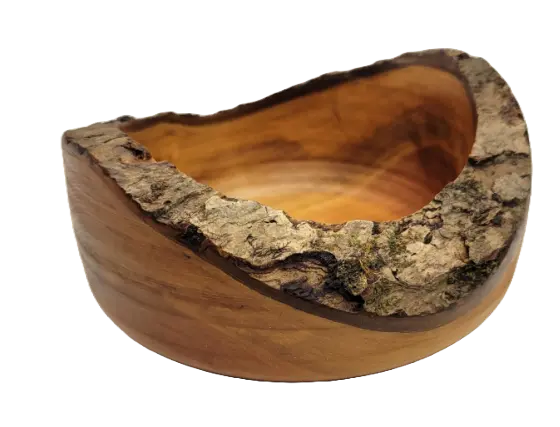
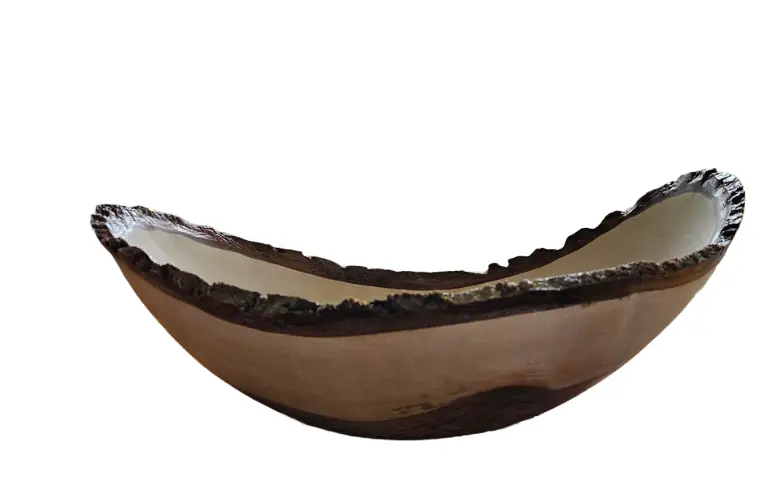
So yes — my clear preference is bowl number two. But if you disagree with me, I’d love to hear it. After all, taste is something we can’t argue about…
Fresh Wood and Risks
Because natural-edge bowls are often turned from fresh (green) wood, there is still a lot of moisture inside the wood. That moisture wants — and needs — to escape, and it doesn’t always do so evenly. The result: internal stress, cracks and sometimes complete splits. And that’s a shame, considering all the work that has already gone into the piece.
That’s why I try to slow down and control the drying process as much as possible, instead of letting the wood do whatever it wants. That starts with creating an even wall thickness and sanding it smooth. And then I often use the product Revivo Esacryl.
Esacryl Aqua
Once the shape of the bowl is finished and it has been roughly sanded, I apply Esacryl Aqua to the surface. Because it is water-based, it mixes with the moisture that is already present in the fresh wood. During drying, it hardens inside the wood, which means:
- the surface becomes more stable
- internal stresses are distributed more gently
- and the risk of cracking and splitting is significantly reducedAn additional advantage is that, once dry, the wood becomes much easier to sand. Especially with fragile natural edges and difficult woods, that is a huge benefit. For me, this is an ideal way to control the drying and finishing of natural-edge bowls, without losing their natural character.
An additional advantage is that, once dry, the wood becomes much easier to sand. Especially with fragile natural edges and difficult woods, that is a huge benefit.
For me, this is an ideal way to control the drying and finishing of natural-edge bowls, without losing their natural character.
What Is Esacryl Originally Intended For?
Revivo Esacryl was originally developed as a wood hardener. It is used to:
- strengthen weak, brittle or porous wood
- harden wood before further processing
- and stabilize the structure of fragile material
It is a water-based product that penetrates into the wood and hardens there during drying. In restoration work and woodworking, it is used to give materials more “body” before sanding, machining or finishing.
That is exactly what also makes it particularly suitable as a tool when working with fresh wood and natural edges.
Esacryl Also as a Finish
After sanding, I sometimes choose to apply a second and even a third coat. In that case, I no longer use it only as a hardener, but also as a final finish. The wood then gets a beautiful, calm appearance that resembles an oiled finish. No thick lacquer layer, but a natural look that perfectly matches the character of a natural-edge bowl.
Important Note
After full curing, Esacryl is safe for decorative use and light applications such as fruit bowls. However, it is not intended for intensive contact with wet food and is therefore not suitable for items such as soup bowls, salad bowls or cutting boards.